
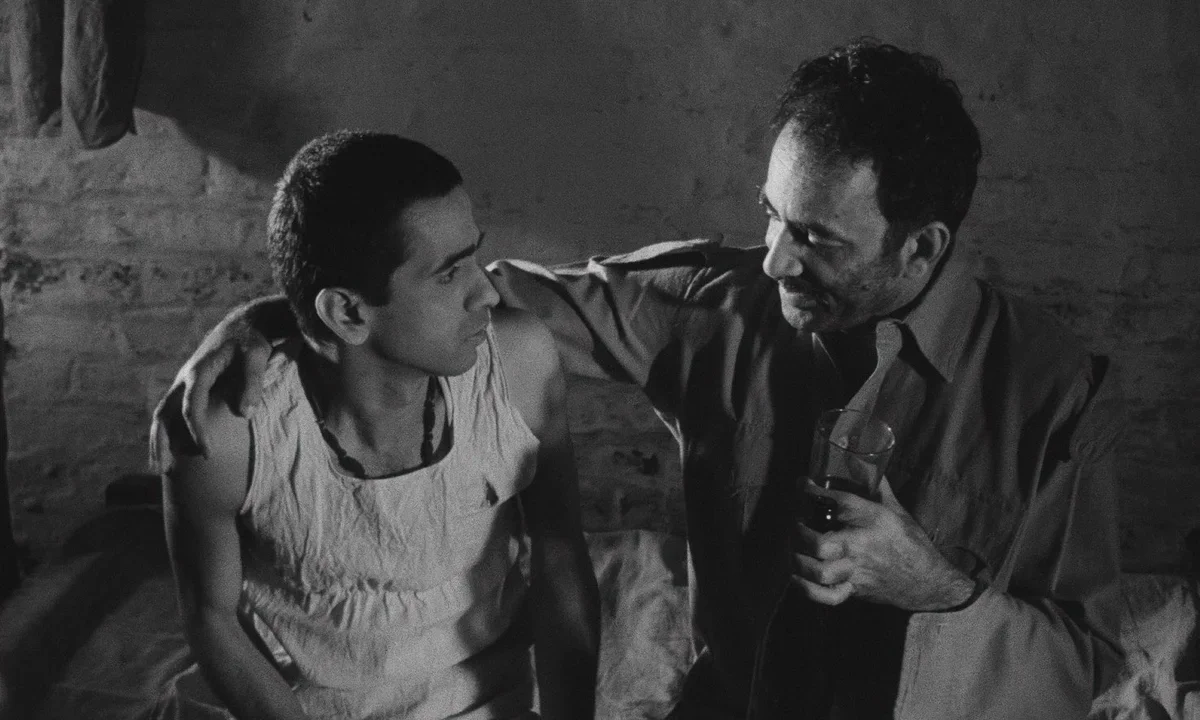
Badnam Basti
In 1970s India, Sarnam, a bandit-turned-truck driver, rescues Bansuri from an assault before finding himself drawn to Shivraj, a temple-bred cleaner he hires to work on his truck. Adapted from Kamleshwar’s 1957 novel Ek Sadak Sattavan Galiyan (A Street with Fifty-Seven Lanes), the film explores desire and intimacy at a time when queer relationships were rarely represented in Indian cinema.
Director Prem Kapoor shot the film in black and white over four weeks in Mainpuri, drawing on influences from German Expressionism and the French Nouvelle Vague. To pass India’s censor board, Kapoor reduced much of the novel’s homoeroticism to suggestion, leaving the relationship between Sarnam and Shivraj to emerge through the film’s dialogue and visual language.
Badnam Basti is a pioneering work of queer Indian cinema that nearly disappeared from history. A 35mm print sent to the Mannheim Film Festival in 1972 was rediscovered at Berlin’s Arsenal archive in 2019, leading to a restoration spearheaded by Kapoor’s son, Hariom Kapoor, and bringing the film back to audiences more than five decades after it was made.